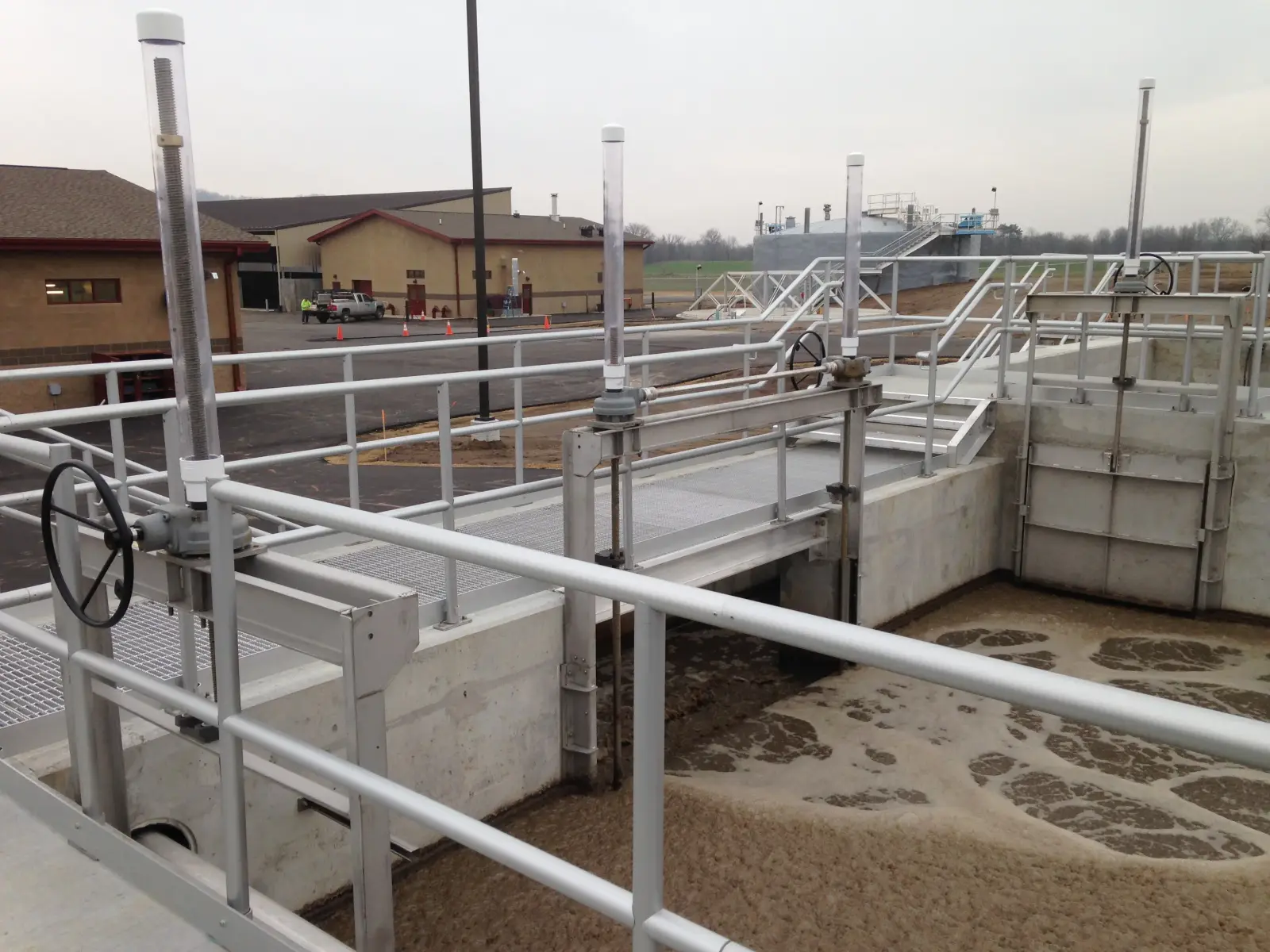
Sluice, Slide and Weir Gates
Control water flow in municipal and industrial applications with robust, long-lasting gates designed for precise regulation.
Technical specifications
General
- The gates shall be provided as specified and as shown in the Contract Documents.
- The gates shall comply with the latest version of AWWA C561 as modified herein.
Definitions
- A stainless steel sluice gate is defined herein as a heavy-duty gate with a four-sided seal system that is used to close off an orifice that experiences a maximum water level that can exceed the top of the orifice.
- A stainless steel slide gate is defined herein as a gate that has a three-sided seal system. The seals are positioned along the sides and across the invert of the opening.
- A stainless steel weir gate is a downward-opening slide gate.
Performance Requirements
- Leakage for stainless steel gates shall be restricted to 0.05 gpm/ft or less of the seal perimeter at the design seating head and the design unseating head.
Submittals
- Submittals shall include, at a minimum, detailed custom drawings of the gate assembly with dimensional and mounting information and a listing of the materials of construction. General arrangement drawings and cut sheets are not considered acceptable drawings.
- Calculations shall be provided to confirm compliance with the safety factors listed in AWWA C561 for all parts of the frame, anchorage and slide including the portion of the slide that engage the frame.
- A copy of the test results from the minimum 30,000 cycle test confirming the durability of the seal system.
- A copy of the ISO 9001:2015 certification.
Quality Assurance
- The basis for the design of the sluice gates and slide gates is the Model RW1000-S as manufactured by RW Gate Company, Troy, NY.
- All gates shall be shop inspected for proper operation prior to shipment.
- Welds shall be performed by welders with ASME Section IX or AWS D1.6 certification.
- The gate manufacturer shall be ISO 9001:2015 certified.
Materials of Construction
- All stainless steel referenced in this specification shall be Type 304, ASTM A240 or ASTM A276 unless otherwise indicated herein.
- All welded stainless steel components shall be constructed of Type 304L stainless steel.
- All structural stainless steel used in the construction of slides and frames shall have a minimum material thickness of 1/4-inch.
- All non-welded stainless steel components, excluding anchor bolts and assembly bolts, shall be Type 304 or Type 304L stainless steel.
- Anchor bolts and assembly bolts shall be Type 316 stainless steel.
Slide
- The slide shall consist of a stainless steel plate that is reinforced with stiffeners to withstand the specified head conditions. The slide shall engage the frame a minimum of 1-inch on each side.
- The slide shall be reinforced with plates or channel shaped members to restrict deflection to 1/16-inch or less at the design head.
- The stiffeners shall be welded to the slide plate in the horizontal and vertical positions.
- The portion of the slide that engages the frame shall have a minimum thickness of 1/2-inch.
- On rising stem gates, a stem connector shall be welded to the slide as a means of connecting the operating stem. The bottom portion of the stem shall be affixed to the stem connector with a minimum of two attachment bolts.
- On non-rising stem gates, the slide shall be arranged to allow travel of the stem along the length of the slide.
Frame
- The frame shall be constructed of stainless steel plate, with the guide section formed into a C channel shape or similar to house the seal, and shall be reinforced to withstand the specified operating conditions.
- The guides shall be of a one-piece design with gussets that extend along the outside and top to accommodate unseating head. The guide members shall incorporate a tubular cross section along the guides for additional rigidity. Two-piece, sandwich type guides that are bolted together are not acceptable.
- The mounting configuration of the frame shall be as shown on the Contract Drawings.
- Wall mounted frames shall be of the flanged frame type. Flat frames shall only be provided on gates with frames that will be embedded in the concrete wall or mounted inside existing channels.
- The guide portion of flanged frame gates shall have a minimum weight of 13 lbs/ft. The guide portion of the flanged frame, where the anchors penetrate, shall have a minimum thickness of 1/2-inch.
- The guide extension portion of the frame shall have a minimum weight of 6 lbs/ft. Angles are not considered acceptable guide extensions.
- Lifting lugs shall be provided on all frame styles.
- On self-contained gates, the side frame shall extend above the operating floor and the operating mechanism shall be mounted to the yoke. When shown, the frame may extend to or below the operating floor and a floorstand may be mounted on the yoke.
- Yoke members shall be C channel shaped structural members. Angles are not considered acceptable yoke members.
Seals
- The seal system shall consist of self-adjusting UHMWPE seals with a nitrile or EPDM compression cord.
- The UHMWPE seals shall be arranged to ensure that there is no metal-to-metal contact between the slide and frame.
- The compression cord shall be contained by the UHMWPE seal so that it shall not be in contact with the slide.
- Seal system shall be self-adjusting for the life of the gate. Adjustable wedging devices such as wedges, wedge bars and pressure pads are not acceptable.
- On upward-opening gates, rubber side seals and/or top seals such as J-bulb seals or similar rubber seals are not acceptable in lieu of UHMWPE seals.
- On downward opening gates, rubber side seals and/or invert seals such as J-bulb seals or similar rubber seals are not acceptable in lieu of UHMWPE seals.
- The invert seal on upward opening gates shall use a compressible EPDM seal located in the invert of the frame.
- The invert seal shall be of a flush bottom arrangement.
- The invert seal shall be mechanically fastened with stainless steel bolts.
- Invert seals attached solely by the use of adhesives are not acceptable.
- All seats and seals shall be secured with assembly bolts. All seals shall be field removable and field replaceable without the need to remove the gate frame from the wall. Gates that require disassembly of any portion of the frame, to replace seals, are unacceptable.
- Anchor bolts shall not penetrate the seats or seals and anchor bolts shall not prevent the removal or replacement of seats or seals.
- The seal system shall have been shop tested with a minimum 30,000 cycle operating test in an abrasive environment to confirm the ability of the seals to withstand the abrasive condition with negligible deterioration and to confirm that the leakage restriction requirement is still possible.
- The shop test shall have been performed on a stainless steel sluice gate and the test results shall have been certified by the manufacturer in writing.
- A copy of the test shall be provided to the Engineer.
Operating Stem
- The operating stem shall be of stainless steel and shall be designed to transmit in compression at least 2 times the rated output of the manual operating mechanism with an 80 lbs effort.
- The stem shall have a slenderness ratio (L/r) less than 200.
- The threaded portion of the stem shall have a minimum diameter of 1-1/2 inches.
- The threads shall have machine rolled, full depth ACME threads.
- Stub threads are not acceptable.
- Stems provided in multiple pieces shall be provided with couplings.
- Couplings shall be bronze or stainless steel and shall be internally threaded and keyed or bored and bolted.
- Stem guides shall be constructed of stainless steel with UHMWPE bushings.
- Gates with rising stems shall be provided with a clear plastic stem cover.
- The stem cover shall be butyrate and shall have a cap and condensation vents.
- Clear mylar indicating tape shall be provided for field application after the gate has been installed and positioned.
- Stop collars shall be provided to limit the downward travel on gates with manual operating mechanisms.
- Stop collars shall be bronze and shall be internally threaded and provided with a stainless steel set screw.
Operating Mechanism
- Operating mechanisms shall be provided by the gate manufacturer.
- Manual operators shall be yoke mounted on self-contained gates or floorstand mounted when shown in the Contract Documents.
- Manual operators shall be of the bevel gear type suitable for operation with a portable operator.
- Gear ratios shall be selected by the gate manufacturer to ensure that the maximum operating effort is 40 lbs at the design head.
- Minimum gear ratio shall be 2:1.
- Gearboxes shall have ductile iron housings, a bronze lift nut, steel gears and a stainless steel input shaft.
- Ball or roller bearings shall support the lift nut and input shaft.
- The housing shall be grease lubricated and permanently sealed.
- Handwheels or cranks shall be provided. Handwheels shall be constructed of epoxy-coated steel or stainless steel and shall have a maximum diameter of 24 inches. Cranks shall be constructed of stainless steel and have a maximum length of 15 inches.
- Adaptor plates shall be utilized to attach the operating mechanism to the yoke. Adaptor plates shall be stainless steel and shall have a minimum thickness of 3/4-inch.
- Electric motor actuators shall be provided a described in Section _____.
- Interconnected gearboxes and multiple stems shall be provided to ensure proper operation of wide gates.
- Interconnected gearboxes are required on all upward opening gates when the opening width is greater than 60 inches and the height of the slide is less than half of the width.
- Interconnected gearboxes are required on all downward opening gates when the opening width is greater than 48 inches and the height of the slide is less than half of the width.
- Interconnected gearboxes shall consist of a stainless steel interconnecting shaft with flexible couplings on each end and stainless steel hardware. Aluminum shafts are not acceptable.
- Gates with interconnected gearboxes, driven by an electric motor operator, shall be provided with a shroud to cover the interconnecting shaft.
- The shroud shall be removable.
- The shroud shall be constructed of stainless steel and shall have a minimum thickness of 20 gauge.
Floorstands and Wall Brackets
- Floorstands shall be mounted to the concrete, mounted to a wall bracket or mounted on the yoke of a self-contained gate as shown on the Contract Drawings.
- All floorstands and wall brackets shall be fabricated from stainless steel.
- The base plate, adaptor plate and gussets shall be minimum 1/2-inch thick.
Anchorage
- Anchor bolts for the gate assembly and appurtenances shall be provided by the gate manufacturer.
- The anchor bolts shall be 316 stainless steel, fully threaded and shall have a minimum diameter of 1/2-inch.
- Anchor bolts shall be of the epoxy type.
Finish
- All heat tint and slag from the welding process shall be passivated in accordance with ASTM A380. If bead blasting is used, the entire slide and entire frame shall be bead blasted.
- All ferrous components shall be suitably prepared and then shop coated with primer. Finish coating shall be applied by the Contractor. The ductile iron operator housing shall be finish coated and/or provided with touch-up paint by the Contractor with a suitable paint that complies with the Painting section.
Installation
- Installation shall be performed in accordance with the gate manufacturer's installation instructions and the approved installation drawings.
- Installation instructions and installation drawings shall be found in the O&M manual.
- Non-shrink grout shall be applied, by the Contractor, between the gate frame and the wall to ensure that there is no leakage around the gate. A 1-inch thick grout pad shall be provided as shown on the installation drawings.
Field Service
- A service technician shall be provided to instruct the Contractor prior to the installation of the first gate. The service technician shall be available for one (1) 8-hour work-day at the project site.
- If electric actuators are provided, a second trip will be provided to set the limit switches on the electric actuators.
Ready to spec Sluice, Slide and Weir Gates for your project?
Our engineering team can help with sizing, materials, and submittals.